
Common yellowjacket
Vespula spp.
12–18 mm
Nests in ground burrows, wall voids, and cavities. The species behind most late-summer stings and patio problems.
Assessment and treatment for wasp and hornet nests around entrances, roofs, sheds and other problem areas.
*Warranty coverage and terms confirmed with your quote. Visits available across our southern Ontario service areas.
Tell us where the insects are entering, roughly how high it is, and how the space is used, and keep the area clear until the visit. We confirm what the nest is, because bees, paper wasps, yellowjackets, and hornets are handled differently, then treat the nest directly or inject the void through the flight entrance. Accessible nests are removed after treatment. The entry point stays open until the colony is confirmed dead, and we tell you which gaps, vents, or soffit repairs would stop a new queen choosing the same spot next spring.
Honey bees are not treated as a pest and are referred to a beekeeper where relocation is possible. Wasp, hornet, and paper wasp nests each call for a different approach distance and method.
Product applied into the nest entrance so returning foragers carry it inside, treating the colony rather than just the workers in flight. Protective equipment and timing, usually early morning or dusk, keep the work controlled.
For nests inside walls, soffits, and ceilings, product is injected into the void through the flight entrance. The entrance is left open until the colony is dead, because sealing it first drives wasps inward through drywall.
Accessible nests are taken down after the colony is treated, which prevents lingering foragers and stops the debris and staining an abandoned nest can leave behind.
Screening vents, closing soffit gaps, and repairing siding after treatment removes the feature that made the site attractive in the first place.
Tell us your city, property type and where you have noticed activity. We explain the proposed service, price and any follow-up before you book. Your quote depends on:
A wasp nest over a doorway turns an ordinary route into a daily calculation, and by late August a mature yellowjacket colony can hold several thousand workers. Wasps sting repeatedly, they defend the nest rather than the individual, and knocking one down with a broom is how most stings happen. Pest Patrol GTA locates the nest, identifies what is in it, and treats it with the protective equipment and approach the location calls for, whether it is a visible paper nest under an eave or a hidden colony inside a wall cavity.
No. Sealing an active entrance traps the colony inside the void, and wasps very often chew their way out through drywall into the room. Leave the entrance open, keep the area clear, and have the nest treated first.
Wasp and hornet nests are made of chewed wood fibre and look like grey paper, either an open umbrella comb or an enclosed football shape. Honey bees build waxy combs and the bees themselves are furry and golden-brown. We refer honey bee colonies to a beekeeper rather than treating them.
Most nests go quiet within a few hours to a day as returning foragers carry product inside. A large or well-insulated wall-void nest can take longer, and some stragglers returning to the site for a day or two afterwards is normal.
The colony peaks in late summer, and brood rearing slows, so workers switch from hunting insects to seeking sugar. That is when they show up around bins, patios, fruit trees, and outdoor dining, even though the nest has been there since spring.
Not to the same nest, which is abandoned after the colony dies off in winter. They do come back to the same kind of site, so an open soffit gap or unscreened vent that hosted a nest this year is likely to host one again. Proofing the site is what breaks the pattern.
Ground-nesting yellowjackets are treated at the burrow entrance, usually at dusk or early morning when most workers are inside. Mark the spot from a distance, keep people and pets away, and do not mow near it, because vibration is the most common trigger for a mass sting incident.
Often yes, though the area around the nest needs to be kept clear for a short period, and scheduling before opening or after close is usually better for customers and staff. Tell us the doorway, patio, or drive-through involved and we will plan access around it.
The pest, the size of the property, how far activity has spread, and the number of visits all affect the price. A single wasp nest is a very different job from a bed bug programme across three rooms. Tell us what you have noticed and where your property is, and we will explain the proposed service and give you a quote before any treatment starts.
We serve Brantford, Hamilton, Cambridge, Waterloo, Brampton, Mississauga and surrounding areas, including Paris, Ancaster, Dundas and Stoney Creek. We also arrange visits elsewhere in southern Ontario. Share your address when requesting a quote so we can confirm service availability.
We visit homes and businesses in Brantford and Hamilton, with service across southern Ontario. Choose your city for local service and booking information.
Identification, hiding places and life cycle help determine how to treat wasps and hornets. These details explain what your technician looks for and why preparation and follow-up can matter.
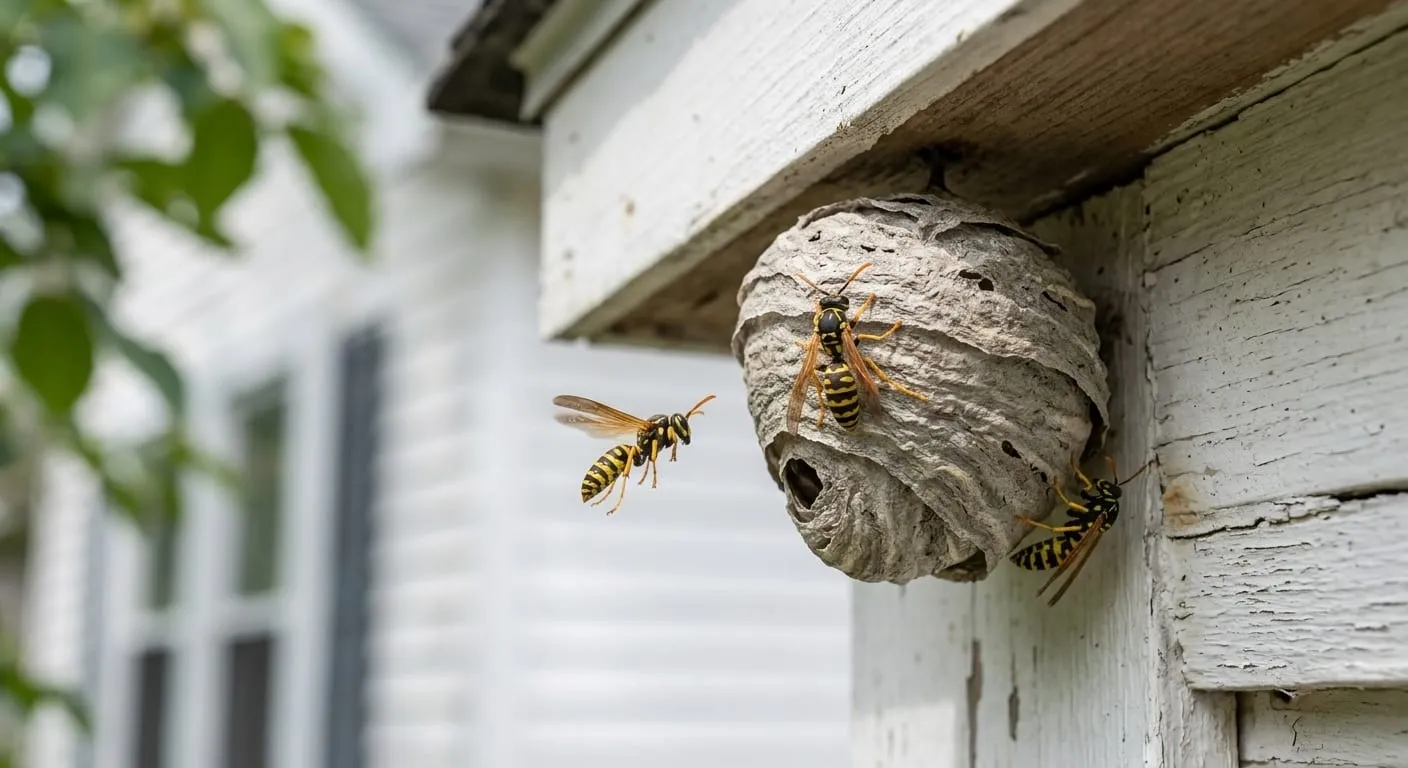
Yellowjackets are stocky, roughly 12 to 18 mm, with sharp black and yellow banding and a tucked flight posture. Paper wasps are slimmer with long trailing legs in flight and build open, umbrella-shaped combs. A bald-faced hornet is larger at 18 to 20 mm, black with white markings on the face and tail, and builds the enclosed grey football nest. Honey bees are furry and golden-brown and should be referred to a beekeeper for removal, not treated as a pest.
Wasp colonies in Ontario are annual. A mated queen overwinters in a sheltered spot, emerges in April or May, and builds a small nest of a few dozen cells alone. Her first workers take over building and foraging, and from then the colony grows through the summer. Numbers peak in August and September, at which point a yellowjacket nest can hold thousands of workers and a bald-faced hornet nest several hundred. New queens leave in autumn, and the rest of the colony, including the founding queen, dies with the first hard frosts. The old nest is not reused the following year.
A single queen builds a nest of a few dozen cells with no workers to defend it. Nests treated at this stage are the smallest, cheapest, and safest to deal with.
Workers take over foraging and expansion. The nest is often still hidden inside a soffit or wall void at this point.
Thousands of workers in a mature yellowjacket nest, defensive and actively seeking sugar. Most stings and most emergency calls happen now.
New queens disperse to overwinter; the rest of the colony dies. The old nest is not reused, but the nesting site usually is.
Aerial nests go under eaves and soffits, inside sheds and garages, in dense shrubs, and on tree branches. Cavity nesters use wall voids, attic spaces, soffit returns, and the space behind siding, entering through a gap that can be smaller than a pencil. Ground-nesting yellowjackets take over abandoned rodent burrows, spaces under decks and steps, and voids inside retaining walls, which makes them the ones most often disturbed by mowing.
Early in the season workers hunt protein, mainly caterpillars and other insects, to feed the developing brood. As the colony matures and brood rearing slows in late summer, the workers switch to sugars. That switch is why wasps suddenly appear around patios, fruit trees, recycling bins, and outdoor dining in August, having been largely unnoticed in June.
Wasps do not infest a building the way rodents or cockroaches do. Each nest is a separate colony started by a single queen. A property that gets nests repeatedly usually offers good nesting sites: open soffit gaps, unscreened vents, sheltered eaves, or undisturbed voids, and those are the things worth changing after the nest is treated.
April and May bring solitary founding queens and small nests that are easy to treat. June and July are when nests grow quickly and are still often unnoticed. August and September bring peak numbers and the sugar-seeking behaviour most people associate with wasps. Activity ends with the first sustained frost, although nests inside heated wall voids can stay active a little later.
Unlike honey bees, wasps can sting repeatedly. Most stings cause local pain and swelling, but a small proportion of people have severe allergic reactions, and a nest disturbed near a doorway, playground, or work area can produce many stings at once. Anyone with a known sting allergy should stay well away and treat a nest near an entrance as urgent.
Vespula spp.
12–18 mm
Nests in ground burrows, wall voids, and cavities. The species behind most late-summer stings and patio problems.
Dolichovespula maculata
18–20 mm
Black with white markings, building the large enclosed grey paper nest in trees and on walls. Defends a wide area around the nest.
Polistes dominula
12–17 mm
Builds small open umbrella combs under railings, in BBQ covers, inside grills, and in patio furniture. Less aggressive but very common around homes.
Vespa crabro
25–35 mm
Large, brown and yellow, and active after dark. Nests in hollow trees, barns, and wall voids in parts of southern Ontario.
“Spray it at night with a can from the hardware store.”
Aerosol range is short, wall-void and ground nests cannot be reached this way, and a partial treatment leaves a defensive colony and an angry population of returning foragers. This is how most serious sting incidents happen.
“Seal the hole and they will die inside.”
Trapped wasps chew outward, and in a wall void that often means through drywall into the room. The entrance stays open until the colony is confirmed dead.
“Knock the nest down and it is over.”
Displaced workers become far more defensive and frequently rebuild nearby. Treating the colony first is what ends it.
“It is too late in the season to bother.”
August and September are exactly when a colony is largest and most defensive. A nest over a doorway in September is more urgent than the same nest in June, not less.
Tell us the pest, your city and the affected areas. We’ll explain your treatment options, pricing and appointment availability before you book.