
German cockroach
Blattella germanica
13–16 mm
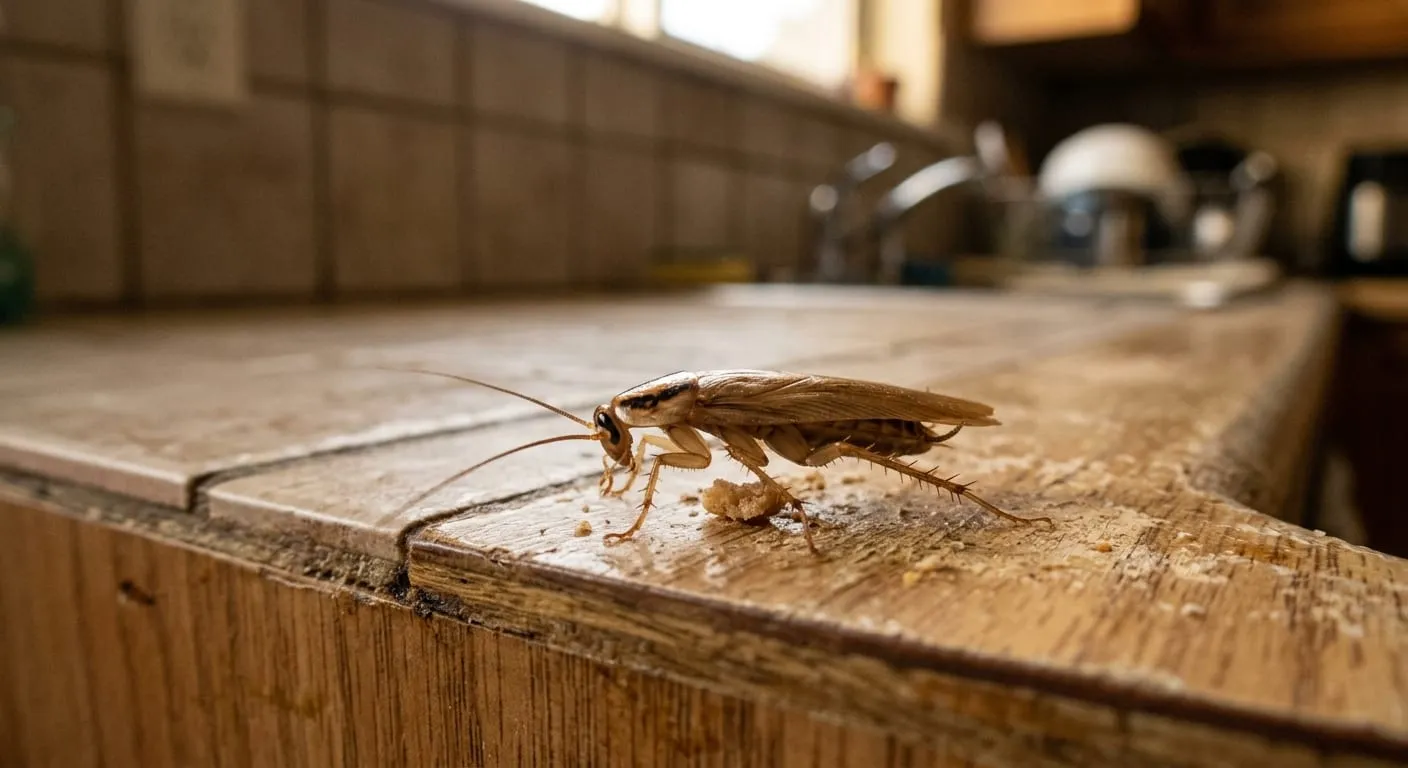
Two dark stripes behind the head. The most common and most difficult species in kitchens, apartments, and restaurants, with documented resistance to several older insecticides.
Target cockroach infestations in kitchens, apartments and businesses with inspection, treatment and monitoring.
*Warranty coverage and terms confirmed with your quote. Visits available across our southern Ontario service areas.
We identify the species first, then map where activity concentrates using monitors rather than guesswork. Treatment is built around gel bait placed inside harbourage, supported by targeted crack-and-crevice application and an insect growth regulator where appropriate. You get a short, specific list of the sanitation and repair items that matter most on your property, which is usually leaks, grease behind equipment, and cardboard. Follow-up visits track the monitor counts, so success is measured rather than assumed, and for food premises we provide the documentation inspectors expect.
German, oriental, and American cockroaches use different parts of a building. Identification decides whether the work concentrates on a kitchen, a drain and basement, or an exterior perimeter.
Small placements of insecticidal gel directly inside harbourage. Cockroaches feed, return to the group, and the effect passes through the population. Gel avoids the dispersal that sprays cause and suits kitchens and food premises.
Targeted residual application to harbourage, often paired with an insect growth regulator that stops nymphs reaching breeding age and reduces egg viability.
Sticky monitors placed to measure whether numbers are actually falling, and to show where activity is concentrated. In commercial sites these traps also form the audit record.
Leak repair, degreasing behind equipment, cardboard reduction, drain maintenance, and sealing gaps around pipework. Without this the bait programme keeps restarting.
Tell us your city, property type and where you have noticed activity. We explain the proposed service, price and any follow-up before you book. Your quote depends on:
One cockroach on a kitchen floor at midnight is rarely one cockroach. German cockroaches in particular reproduce fast, hide in gaps you cannot see into, and become resistant to the sprays people reach for first. Effective cockroach control starts with identifying the species, because a German cockroach infestation in a kitchen and an oriental cockroach problem in a damp basement need completely different plans. Pest Patrol GTA combines that identification with gel baiting, harbourage treatment, and the moisture and sanitation changes that decide whether the problem returns.
Look for the two dark parallel stripes on the shield behind the head and a body of 13 to 16 mm. Oriental cockroaches are darker and rounder at about 25 mm, and American cockroaches are much larger with a pale figure-of-eight marking. Photograph one next to a coin if you can.
With a correctly placed gel bait programme, most people notice a clear drop within one to two weeks, and a German cockroach population usually collapses over four to eight weeks with follow-up visits. Heavier infestations in cluttered or multi-unit properties take longer because harbourage is harder to reach.
Sprays rarely reach the gaps where cockroaches live, they do not affect the egg case the female carries, and many populations are resistant to older products. The repellent effect also pushes survivors into wall voids and neighbouring rooms, so the infestation spreads rather than ends.
They can carry bacteria mechanically from drains and waste onto food surfaces, and their droppings and shed skins are a recognised indoor allergen and asthma trigger, particularly for children. That allergen load is the stronger reason to deal with an infestation properly rather than living with it.
In most cases yes. Gel baiting and crack-and-crevice work are usually scheduled around service hours, often early morning or after close. Tell us your operating hours, equipment access, and any areas that must stay clear, and the plan is built around them.
Those are egg cases. Each German cockroach case holds roughly 30 to 40 eggs. Finding them means the population is breeding on site rather than wandering in from elsewhere, so treatment should be planned rather than improvised.
Often not on its own. Cockroaches move through shared plumbing chases and wall voids, so a single treated unit can be re-infested from next door. Report the problem to your property manager so neighbouring units can be inspected and treated on the same schedule.
The pest, the size of the property, how far activity has spread, and the number of visits all affect the price. A single wasp nest is a very different job from a bed bug programme across three rooms. Tell us what you have noticed and where your property is, and we will explain the proposed service and give you a quote before any treatment starts.
We serve Brantford, Hamilton, Cambridge, Waterloo, Brampton, Mississauga and surrounding areas, including Paris, Ancaster, Dundas and Stoney Creek. We also arrange visits elsewhere in southern Ontario. Share your address when requesting a quote so we can confirm service availability.
We visit homes and businesses in Brantford and Hamilton, with service across southern Ontario. Choose your city for local service and booking information.
Identification, hiding places and life cycle help determine how to treat cockroaches. These details explain what your technician looks for and why preparation and follow-up can matter.
A German cockroach is 13 to 16 mm, light brown, with two dark parallel stripes running down the shield behind its head. An oriental cockroach is around 25 mm, very dark brown to near black, and slow-moving. An American cockroach is much larger at 35 to 40 mm, reddish-brown, with a pale figure-of-eight marking on that same shield. Brown-banded cockroaches are small like German ones but carry pale bands across the wings and spread higher up a room, including behind picture frames and inside electronics.
A female German cockroach carries her egg case until just before it hatches, which protects it from most sprays, then releases around 30 to 40 nymphs. Development to adult takes roughly six to twelve weeks indoors, and a female can produce four to eight egg cases in her life. Several overlapping generations in a warm kitchen is why numbers appear to explode. Oriental and American cockroaches develop more slowly, over several months to a year, but reach much larger sizes.
A protective brown capsule holding 30 to 40 eggs. Because the female carries it, sprays often miss it entirely, and a new generation appears after the treatment looked successful.
Wingless and darker than adults, moulting several times. Nymphs stay deep in harbourage, so bait placement inside the gap matters far more than treating open floors.
Breeding continuously in a warm building. Overlapping generations are why numbers seem to jump rather than climb steadily.
Cockroaches want warmth, moisture, and a tight space that touches their body on several sides. That means motor housings of fridges and dishwashers, the void behind kickboards, cupboard hinges and corners, hollow table legs, cardboard stacked near a warm wall, drain surrounds, and the gap behind wall tiles. Oriental cockroaches prefer cool damp places instead: floor drains, sump areas, crawl spaces, and basement storage.
They are omnivorous scavengers: grease films, food debris, starches, pet food, soap residue, cardboard glue, and even the paste behind wallpaper. Access to water matters more than access to food, so leaks, condensation, and standing water under a sink drive activity more than crumbs do. They feed on each other's droppings, which is what makes gel bait so effective when it is placed correctly.
German cockroaches almost always arrive as hitchhikers, in cardboard deliveries, grocery bags, second-hand appliances, restaurant supply boxes, laundry baskets, and moving cartons. In apartments and connected commercial units they also move along plumbing chases, shared wall voids, and service risers. American and oriental cockroaches more often come in from drains, sewer connections, and exterior openings at ground level.
German cockroaches live indoors in heated buildings and are active all year in Ontario. Oriental and American cockroaches become more visible in late summer and autumn, and after heavy rain when water pushes them out of drains and sewer connections into basements and ground-floor service areas.
Cockroaches walk through drains and waste and then across food surfaces, carrying bacteria mechanically on their bodies. The better-documented health issue is allergy: cockroach droppings, shed skins, and body fragments are a recognised indoor allergen and a known asthma trigger, particularly for children in multi-unit housing. For food businesses, a visible cockroach can mean a failed inspection and a closure order.
Blattella germanica
13–16 mm
Two dark stripes behind the head. The most common and most difficult species in kitchens, apartments, and restaurants, with documented resistance to several older insecticides.
Blatta orientalis
20–25 mm
Very dark, slow, and tied to cool damp areas: floor drains, sump pits, basements, and crawl spaces. Often called a waterbug.
Periplaneta americana
35–40 mm
The largest of the group, reddish-brown with a pale figure-of-eight marking. Found around boiler rooms, sewer connections, and large commercial kitchens.
Supella longipalpa
10–14 mm
Pale bands across the wings. Unlike other species it spreads high and dry, into furniture, picture frames, and electronic equipment.
German cockroaches travel through the gaps around plumbing stacks, along shared wall voids, and behind kitchen and bathroom fixtures. In a building with a riser running through it, the unit that reports cockroaches is frequently not the unit with the source population.
This is why reactive, unit-by-unit treatment is the single most reliable way to keep a building infested for years. Each treated unit clears, then gets recolonised from an untreated neighbour within weeks, and everyone concludes the treatment did not work.
The approach that does work is stack-based: inspect and treat the units above and below the reporting one at the same time, place monitors through the riser to find where the population actually lives, and service the whole set on one schedule. It costs more on the first visit and far less over a year.
A fogger or bug bomb releases product into open air, where it settles on surfaces. Cockroaches live inside gaps, motor housings, and voids that the product never reaches, so the population survives almost intact.
Worse, most consumer products are repellent. Cockroaches respond by moving away from the treated area, which means deeper into wall voids, up into ceiling spaces, and into neighbouring rooms and units. A problem confined to one kitchen becomes a problem across a floor.
Broadcast spraying also contaminates gel bait placements. Cockroaches stop feeding on treated bait, which removes the most effective tool available. If you have already sprayed, say so, because it changes how the bait programme has to be set up.
The health issue with cockroaches is not primarily what they carry on their feet. It is allergen: their droppings, shed skins, saliva, and body fragments accumulate as fine particles in dust and are a recognised trigger for asthma and allergic rhinitis.
The effect is strongest for children in multi-unit housing, where exposure is long-term and the source is often in a neighbouring unit rather than their own. Allergen persists after the insects are gone, so thorough cleaning of affected cupboards, floors, and soft furnishings is part of finishing the job rather than an optional extra.
For anyone in a household with asthma, this is the reason to treat a cockroach problem properly rather than living with a low-level population.
Do not deep clean immediately before a gel bait visit. Degreasing every surface right before the technician arrives sounds helpful, but cockroaches that have just lost their food supply behave unpredictably and heavy cleaning can disturb the harbourage we need to find.
Do clear the cupboards and drawers you are asked to, empty and clean under the sink, and make the space behind the fridge, stove, and dishwasher accessible. Those voids are where the population actually lives.
Do fix the water. A dripping tap, a leaking trap, or condensation under a sink matters more to a cockroach population than crumbs do, and leaving it unresolved is the most common reason a bait programme stalls.
After treatment, leave the bait placements alone. Wiping them away because they look untidy removes the treatment.
Live insects in a food preparation or storage area are the obvious finding, but an inspection also looks at evidence: droppings in cupboard corners and on shelf runners, egg cases in hinge recesses, shed skins behind equipment, and staining in appliance voids.
Equally important is the record. A current service log, a site map with numbered monitoring points, dated product records, and a corrective action list showing what was found and what was done about it demonstrate an operation in control. An empty folder and a recent spray does not.
Structural and process items come up repeatedly: gaps under receiving doors, cardboard stored against warm walls, floor drains without maintenance, and equipment that cannot be moved for cleaning. Fixing those is what stops the cycle, and they belong on a ranked action list rather than being treated around indefinitely.
“Cockroaches mean the place is dirty.”
German cockroaches arrive in deliveries and belongings and thrive anywhere warm with water. Spotless apartments and new restaurants get them. Sanitation affects how fast the population grows, not whether it arrives.
“A bug bomb or fogger will clear the kitchen.”
Foggers deposit product on open surfaces, not inside the gaps where cockroaches live, and the repellent effect drives them deeper into wall voids and neighbouring units. They routinely make an infestation worse and harder to bait.
“Spraying everything is the fastest route.”
Broadcast spraying contaminates bait placements so cockroaches stop feeding on them, and many German cockroach populations are already resistant to older sprays. Targeted gel and growth regulators outperform it.
“They are gone because I stopped seeing them.”
Reduced sightings can simply mean the survivors moved deeper into harbourage. Monitoring traps are what confirm that a population has actually collapsed.
Tell us the pest, your city and the affected areas. We’ll explain your treatment options, pricing and appointment availability before you book.