
Cat flea
Ctenocephalides felis
1.5–3.3 mm
The flea behind almost every Ontario case, on dogs as often as cats, and the one found on raccoons, skunks, and opossums as well.
Home flea treatment with preparation, vacuuming and follow-up guidance to coordinate with your pet’s veterinary care.
*Warranty coverage and terms confirmed with your quote. Visits available across our southern Ontario service areas.
The first job is to work out which host is feeding them, because a home with no pet points at wildlife or rodents and that changes the whole plan. From there we map the resting places rather than the rooms, since eggs and larvae concentrate where the animal sleeps and lies. Treatment pairs a growth regulator, which stops the next generation maturing, with a targeted residual at floor level, along carpet edges, into floor gaps, and under the furniture the animal uses. You get a written preparation list beforehand, because vacuuming and laundering genuinely change the outcome here, and a follow-up is planned from the start for the adults that will emerge from cocoons over the following fortnight. We ask that your vet's on-animal product is current at the same time; the two halves only work together.
An IGR stops eggs and larvae developing into biting adults, and keeps working for months. It is the part of the treatment that closes the cycle rather than thinning the current generation.
Applied to carpet, carpet edges, floor gaps, and under and behind the furniture the animal rests against, because that is where the larvae are. Open floor in the middle of a room matters far less.
Thorough vacuuming before and repeatedly after treatment removes eggs, larvae, and larval food, and the vibration coaxes adults out of cocoons and onto treated surfaces. The bag or canister is emptied outside straight away.
Pet bedding, throws, and washable covers go through a hot wash and a hot dryer cycle. These items hold a disproportionate share of the eggs and larvae.
A second visit around two to three weeks out deals with adults that emerged from cocoons after the first treatment. This is built into the plan from the start, not sold afterwards.
Where the fleas came from a raccoon in the soffit or mice in a wall void, the animals and the nest material have to be dealt with or the same thing happens again next season.
Tell us your city, property type and where you have noticed activity. We explain the proposed service, price and any follow-up before you book. Your quote depends on:
The fleas you can see on a pet are a small fraction of the problem. For every adult flea on the animal there are roughly twenty more as eggs, larvae, and pupae in the carpet, in the pet's bed, and in the gaps between floorboards, which is why flea treatment that stops at the animal so reliably fails. The cocoon stage makes it harder still: it shrugs off insecticide and can wait months for a passing footstep before the adult emerges. Pest Patrol GTA treats the environment and the harbourage where the young stages actually live, times the follow-up around that cocoon window, and works alongside whatever your vet has put the animal on.
Because of the cocoon. No product reliably penetrates it, so adults keep emerging for two to three weeks after a treatment, walk onto the treated surface, and die there. Continued sightings in that window are expected. Vacuuming often actually speeds it up, since the vibration triggers emergence. What matters is that numbers are falling by the follow-up visit.
Yes, and it is common. Raccoons, squirrels, and skunks in a roof space, soffit, or under a deck carry cat fleas, as do mice and rats. When that animal leaves, is removed, or dies, the fleas are left without a host and move into the living space. If there is no pet, the inspection starts in the attic and under the deck rather than the carpet.
Yes, and it should be a veterinary product rather than a supermarket collar or shampoo. Environmental treatment without an on-animal product leaves a walking reservoir that reseeds the floor; an on-animal product without environmental treatment leaves the carpet reseeding the animal. Ask your vet to have the pet current around the time of the visit.
Fleas emerge from the floor and jump to reach a host, roughly 18 cm at a time, so lower legs and ankles are what they can get to. Bites are usually small, intensely itchy, and in loose clusters. Bites spread across the torso, arms, and shoulders point away from fleas and more often toward bed bugs.
Most homes are clear within three to six weeks from the first treatment. That timeline is set by the life cycle rather than the product: the growth regulator has to catch the eggs and larvae already in the carpet, and the cocoons have to finish emerging. Where a wildlife or rodent source is still active, it holds steady instead of falling.
You will be asked to stay out while the treatment is applied and until surfaces are dry, typically a few hours; the written instructions give the time for your job. Fish tanks are covered and their pumps turned off, and birds and small caged animals are moved out beforehand. Cats and dogs return once surfaces are dry.
Not for at least two weeks, because wet cleaning lifts the residual and the growth regulator straight back out of the pile. Vacuum as much as you like in the meantime, which helps. If the carpet badly needs cleaning, do it before the visit rather than after.
That is the classic pre-emerged adult problem. Cocoons from the previous occupant's pet sit dormant in an empty property, sometimes for months, and the warmth, vibration, and carbon dioxide of people moving back in triggers them all at once. It says nothing about how clean the property is, and it responds normally to treatment.
The pest, the size of the property, how far activity has spread, and the number of visits all affect the price. A single wasp nest is a very different job from a bed bug programme across three rooms. Tell us what you have noticed and where your property is, and we will explain the proposed service and give you a quote before any treatment starts.
We serve Brantford, Hamilton, Cambridge, Waterloo, Brampton, Mississauga and surrounding areas, including Paris, Ancaster, Dundas and Stoney Creek. We also arrange visits elsewhere in southern Ontario. Share your address when requesting a quote so we can confirm service availability.
We visit homes and businesses in Brantford and Hamilton, with service across southern Ontario. Choose your city for local service and booking information.
Identification, hiding places and life cycle help determine how to treat fleas. These details explain what your technician looks for and why preparation and follow-up can matter.
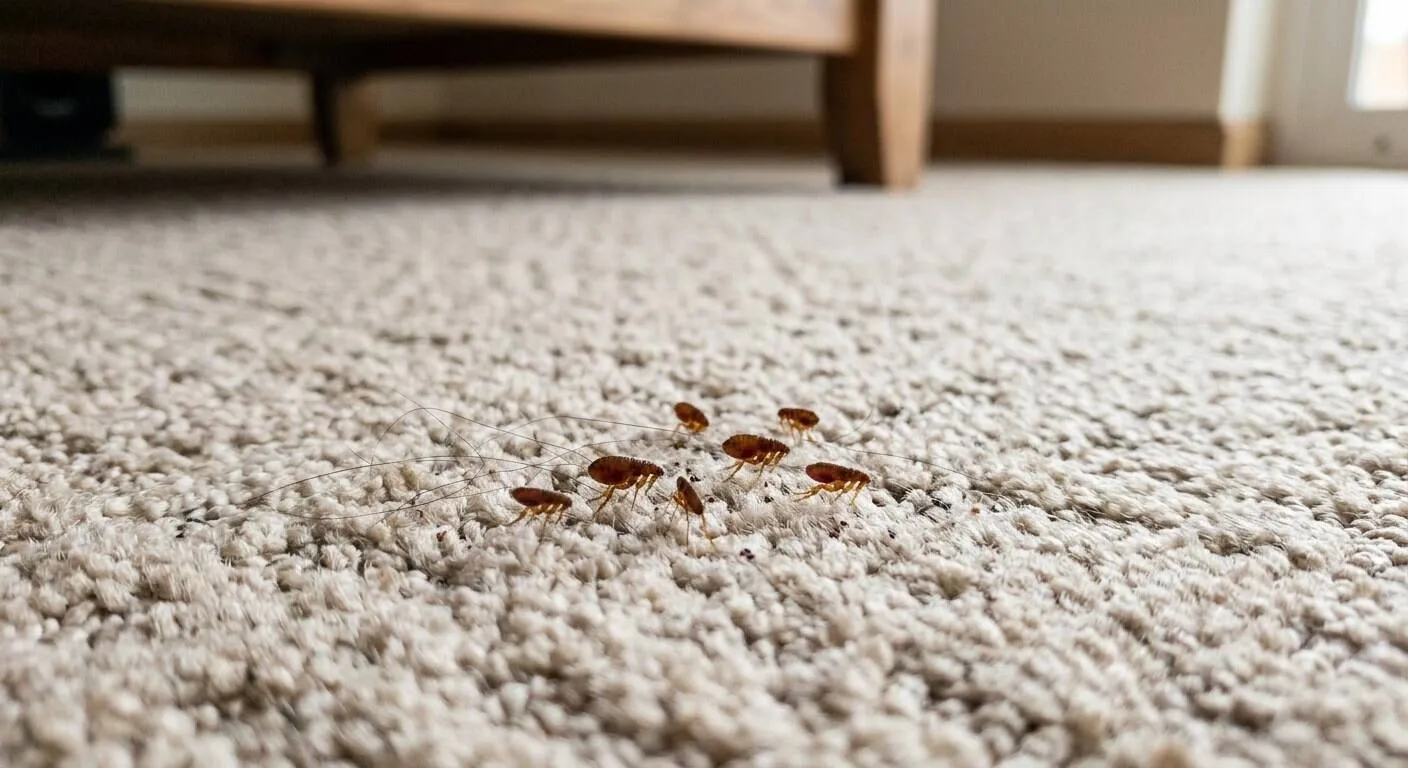
An adult flea is 1.5 to 3.3 mm, dark reddish-brown, wingless, and flattened side to side rather than top to bottom, which lets it move through hair against the grain. It has no wings at any stage and does not fly; it jumps, up to about 18 cm vertically, which is how it reaches ankles and how it gets onto a passing animal. Under a lens the body is covered in backward-pointing bristles and combs. On a carpet the specks people notice are often not fleas at all but flea dirt, and the damp tissue test settles it: dried blood smears rust-red, ordinary dirt does not.
Complete metamorphosis through egg, larva, pupa, and adult. A female feeds within minutes of reaching a host and begins laying about a day later, producing roughly 40 to 50 eggs a day and well over a thousand in a lifetime. The eggs are smooth and are not glued on, so they fall off wherever the animal goes, which seeds the whole house rather than the pet. In a warm Ontario home the cycle can close in about three weeks, but in a cool basement or an empty property it stretches to several months. Around 95 per cent of the population at any moment is egg, larva, or pupa in the environment, not adult fleas on the animal.
Laid on the animal but not glued on, so they roll off into carpet, bedding, and floor gaps. Roughly half the population at any time.
Blind, light-avoiding, and living at the base of the carpet pile, feeding on the dried blood the adults drop rather than biting.
A sticky, debris-coated cocoon that resists insecticide and vacuuming. The adult inside can wait for vibration, warmth, or exhaled carbon dioxide before emerging.
Feeds within minutes of finding a host and starts laying within a day. About 5 per cent of the total population.
The young stages live where the animal rests, not where it walks. Larvae avoid light and work their way down to the base of carpet pile, into the gaps between floorboards, under the edges of area rugs, into upholstery seams, pet bedding, and the dust under beds and sofas that never gets vacuumed. Outdoors they persist in shaded, humid ground under decks, porches, and shrubs where cats, raccoons, or skunks lie up. Sunny open lawn is hostile to them and rarely needs treating.
Only the adult takes blood, and it feeds frequently, often several times a day, staying on the host between meals rather than returning to a harbourage the way bed bugs do. The larvae do not bite at all: they feed on flea dirt, the dried blood the adults pass, which falls into the carpet along with the eggs. That detail matters for treatment, because it means the larvae are concentrated exactly where the pet sleeps, and it is why vacuuming those places removes food as well as insects.
Fleas usually arrive on an animal: a pet that has been outdoors, at a kennel, at a groomer, or in a park. They also arrive without one. Raccoons, skunks, squirrels, and rodents in an attic, soffit, crawlspace, or under a deck carry them, and when that animal is removed or dies the fleas are left without a host and move indoors looking for another, which is the usual explanation for a flea problem in a home with no pet. Within a building they spread as eggs dropping off the animal along its routes, so the trail runs from bed to sofa to favourite patch of sun.
Flea pressure in southern Ontario builds through summer and peaks from August into October, which is when most calls come in. Heated buildings then carry the population straight through winter, so an indoor infestation does not resolve with the first frost. Outdoor stages are knocked back hard by a cold winter, but pets, wildlife in a warm roof space, and cocoons in a heated room all bridge the gap to spring.
Flea bites cause an itchy papule with a central punctum, usually on the lower legs, and scratching them open invites secondary infection. The larger burden falls on animals: flea allergy dermatitis is one of the most common skin diseases in dogs and cats, a heavy burden can cause anaemia in kittens, puppies, and elderly animals, and fleas transmit the tapeworm Dipylidium caninum when a grooming animal swallows one. Fleas also circulate Bartonella henselae, the cat scratch disease organism, between cats. Human-to-human disease transmission from fleas is not a practical concern in Ontario.
Ctenocephalides felis
1.5–3.3 mm
The flea behind almost every Ontario case, on dogs as often as cats, and the one found on raccoons, skunks, and opossums as well.
Ctenocephalides canis
1.5–3.5 mm
Genuinely uncommon here and separable only under magnification. A flea on a dog is far more likely to be a cat flea.
Nosopsyllus fasciatus
3–4 mm
Associated with rodents rather than pets. Turns up after a mouse or rat population is removed and the fleas look for a replacement host.
Pulex irritans
2–3.5 mm
Rare in modern Canadian housing despite the name, and most often linked to livestock, outbuildings, or wildlife rather than homes.
“We have no pets, so it cannot be fleas.”
Fleas do not need your pet, only a warm-blooded host. Raccoons in a soffit, squirrels in an attic, a stray cat under the deck, or mice in a wall void all bring them in, and when that host leaves the fleas come looking for a replacement indoors.
“Treating the pet is enough.”
On-animal products are essential and they work, but roughly 95 per cent of the population is in the carpet and bedding as eggs, larvae, and cocoons. The animal keeps being recolonised from the room until the room is dealt with too.
“A flea bomb or fogger will clear the house.”
Foggers deposit on open upward-facing surfaces. They do not reach the base of the carpet pile, under the sofa, or into floor gaps, which is precisely where the larvae are, and the cocoons are unaffected regardless.
“One treatment should end it.”
Nothing available reliably kills a flea inside its cocoon. Adults keep emerging for weeks afterwards, which is normal and expected rather than a sign the treatment failed. The follow-up visit and the growth regulator are what close it out.
“Fleas live on people.”
They will bite you, usually around the ankles, but human skin and hair do not support a population. Fleas found on a person came from the floor or from an animal and will not establish on you.
Tell us the pest, your city and the affected areas. We’ll explain your treatment options, pricing and appointment availability before you book.