
Common bed bug
Cimex lectularius
4–5 mm
The species found in Canadian homes, hotels, and apartments. Tolerant of cooler indoor temperatures than its tropical relative.
Professional bed bug inspection and removal, including Aprehend biological treatment, with clear preparation and follow-up guidance.
*Warranty coverage and terms confirmed with your quote. Visits available across our southern Ontario service areas.
Our bed bug exterminators start with identification and an inspection of affected rooms. We explain whether Aprehend, another targeted residual treatment or heat is suitable, along with preparation, price and follow-up. For apartments and connected buildings, we also discuss neighbouring-unit inspections and access with the property manager.
Before anything else, the insect is confirmed. Carpet beetles, bat bugs, and spider beetles are all mistaken for bed bugs, and each one leads to a different plan.
A professional bed bug spray treatment using fungal spores. Ask our exterminators whether Aprehend suits your property, furnishings and infestation.
Professionally monitored heat can kill bed bugs and eggs when the required temperature and exposure time are reached throughout the treated items. We discuss suitability, heat-sensitive belongings and preparation before recommending this method.
Registered products applied precisely to harbourage rather than broadcast across surfaces. Applied correctly, a residual keeps working on bugs that emerge after the visit, which is what covers the hatching eggs.
Zippered encasements trap anything remaining inside, make future inspection far easier, and are much cheaper than replacing a bed. They stay on for at least a year.
Follow-up timing depends on the treatment chosen. Monitoring checks for live bed bugs and newly hatched nymphs; the absence of bites alone does not confirm that an infestation has cleared.
Aprehend® is a professional biological bed bug treatment made with Beauveria bassiana fungal spores. It is applied to selected bed bug travel routes, where insects pick up spores and can carry them back to their hiding places. Ask Pest Patrol GTA about Aprehend for your home, apartment or commercial property.
Aprehend works through contact with treated surfaces. Exposed bed bugs typically die within 4 to 10 days; bugs still in hiding may make contact later. This means activity can continue after treatment and the whole infestation needs monitoring.
The Canadian label describes up to three months of residual activity under its stated temperature and humidity conditions. It recommends inspection 30 days after treatment, with further application if live bed bugs remain. Product residual activity and your service warranty are different; your quote explains the warranty coverage.
Read the Canadian Aprehend product label (PDF) and manufacturer's treatment overview for product details. Your technician provides instructions for your property.
Tell us your city, property type and where you have noticed activity. We explain the proposed service, price and any follow-up before you book. Your quote depends on:
Bed bugs are the pest people most often try to handle alone, and the one where doing so usually makes things worse. They hide in seams and cracks within a few metres of where you sleep, they survive months without feeding, and over-the-counter sprays scatter them into neighbouring rooms and units. Pest Patrol GTA confirms the identification first, inspects the rooms that are actually involved, and builds a treatment plan with the preparation steps and follow-up visits written down before anyone starts moving furniture.
Aprehend is a professional biological bed bug treatment containing Beauveria bassiana fungal spores. Bed bugs pick up spores when they cross treated surfaces and can transfer them to other bed bugs. Inspection determines where treatment is needed.
Exposed bed bugs typically die within 4 to 10 days of contact with Aprehend. This is not a deadline for clearing the whole infestation: hidden bugs may reach a treated surface later. A follow-up inspection checks the result.
The quote depends on affected rooms, furniture, infestation level, access and follow-up needs. Tell us your city, property type and where you have seen activity for an Aprehend treatment quote with the proposed scope and warranty terms.
Follow your written preparation sheet. Bag affected laundry before moving it, complete the specified washing and drying steps, and clear access around beds and furniture. Keep cleaned items sealed as directed and tell us about previous pesticide use.
Typically small, raised, itchy welts, often in a line or loose cluster on skin exposed while sleeping. Reactions vary widely and some people never react, so bites alone neither confirm nor rule out bed bugs. Look for faecal spotting, shed skins, and eggs before drawing a conclusion.
Adults commonly survive several months at normal room temperature and longer in cool conditions. This is why leaving a room or apartment empty does not solve the problem, and why a property that has been vacant for a while can still have live bugs.
Professional heat treatment can kill eggs when the required temperature and exposure time are reached at their hiding places. Room air temperature alone does not establish that every item has been treated successfully.
The number depends on the method, infestation and follow-up findings. Aprehend and conventional residual treatments have different inspection schedules. Your quote explains the planned visits and when further treatment may be needed.
Wait for the written preparation list, and do not start bagging or moving things before you have it. Moving belongings to another room is one of the most common ways an infestation spreads. Generally you will be asked to launder and hot-dry bedding and clothing from the affected room and keep it sealed until after treatment.
People and pets must leave the treatment area as directed. For Aprehend in Canada, keep out of treated areas until the spray is dry and follow your technician's ventilation and re-entry instructions. Other products and heat treatments have their own requirements.
Ask for an inspection rather than waiting for bites. Bed bugs move between connected units through wall voids and service chases. Early inspection of the units next to, above, and below an affected one is much cheaper than treating them later, and in most buildings the property manager coordinates that.
In Ontario, landlords are generally responsible for maintaining a rental in a good state of repair and fit for habitation, which includes pest treatment, while tenants are expected to cooperate with access and preparation. Report the problem in writing, keep dated records, and contact the Landlord and Tenant Board if you need guidance on a dispute.
The pest, the size of the property, how far activity has spread, and the number of visits all affect the price. A single wasp nest is a very different job from a bed bug programme across three rooms. Tell us what you have noticed and where your property is, and we will explain the proposed service and give you a quote before any treatment starts.
We serve Brantford, Hamilton, Cambridge, Waterloo, Brampton, Mississauga and surrounding areas, including Paris, Ancaster, Dundas and Stoney Creek. We also arrange visits elsewhere in southern Ontario. Share your address when requesting a quote so we can confirm service availability.
Serving homes, apartments and businesses in Brantford, Hamilton, Cambridge, Waterloo, Brampton, Mississauga and surrounding areas. Contact us to discuss bed bug treatment at your property.
Identification, hiding places and life cycle help determine how to treat bed bugs. These details explain what your technician looks for and why preparation and follow-up can matter.
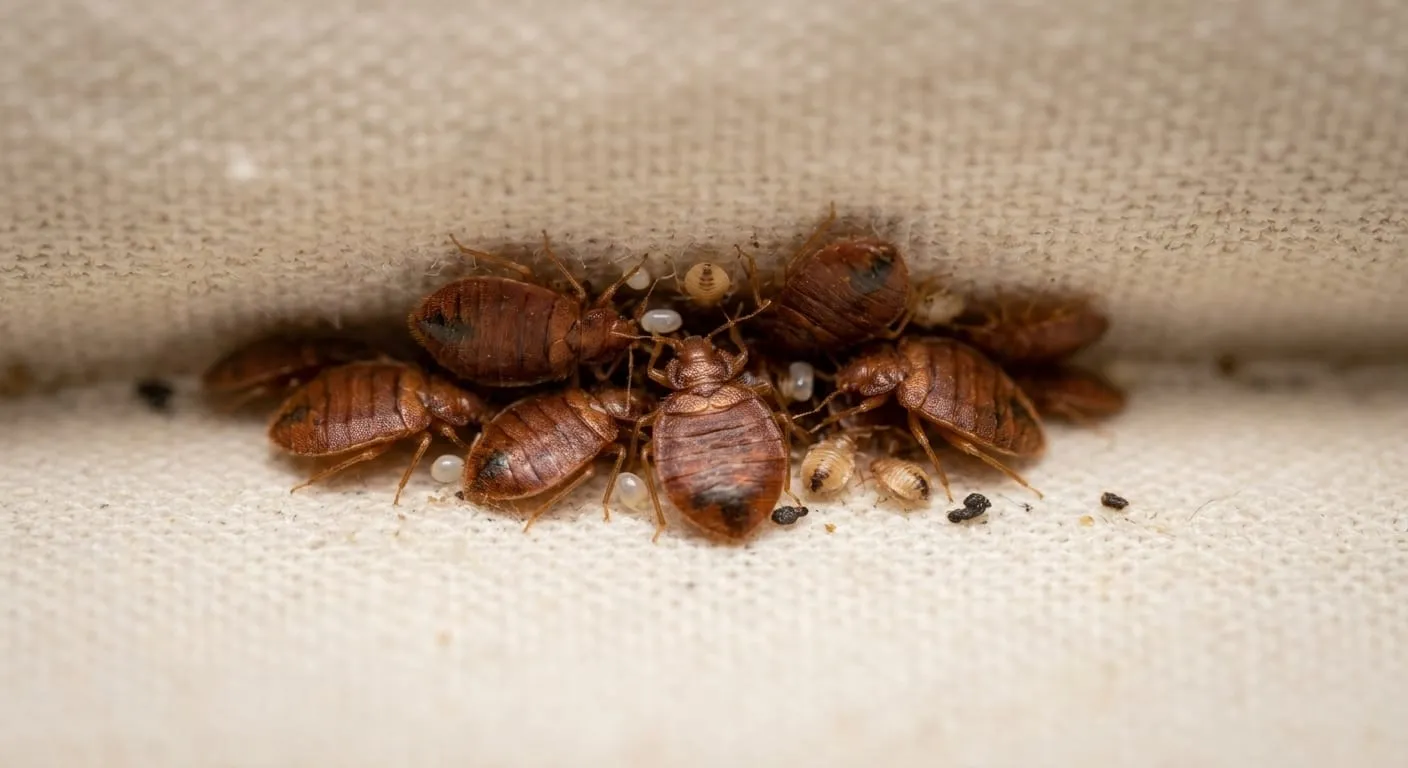
An adult bed bug is 4 to 5 mm long, about the size and colour of an apple seed: flat, oval, reddish-brown, and wingless. After feeding it swells and darkens, becoming longer and more cylindrical. Nymphs are smaller and straw-coloured until they feed, when the blood meal shows as a dark spot through the body. Eggs are around 1 mm, pearly white, and glued into cracks in small clusters.
A female lays roughly one to five eggs a day and several hundred over her life. Eggs hatch in about six to ten days at normal room temperature. There are five nymphal stages, and each one must take a full blood meal before it can moult to the next. From egg to breeding adult takes about five to seven weeks at 21 to 27 degrees, and longer in a cooler room. Because the stages overlap, a treated room can still produce newly hatched nymphs days later, which is exactly why follow-up matters.
About 1 mm, white, and cemented into cracks. Eggs resist many contact sprays, which is the main reason a single treatment is rarely enough.
Each instar needs one blood meal before moulting. The shed skins left behind are often the first hard evidence found during an inspection.
Feeds roughly weekly, reproduces continuously, and survives long fasting periods. A vacant room does not clear itself out.
The classic hiding places are within about 1.5 m of where a person sleeps: mattress seams and tags, box spring fabric and corner guards, bed frame joints and screw holes, headboards and the wall behind them, and the nightstand. As numbers grow, bugs move outward to baseboards, carpet edging, curtain hems, picture frames, electrical outlet plates, upholstered chairs, and the seams of sofa cushions where someone naps.
Bed bugs feed on blood, usually in the hours before dawn, and are drawn by exhaled carbon dioxide, body heat, and skin chemistry. A feed takes three to ten minutes, after which the bug returns to harbourage to digest. They do not live on the body or in hair, which distinguishes them from lice and scabies. Adults commonly survive several months without feeding at room temperature and longer in cool conditions, so an empty apartment does not clear itself.
Bed bugs travel on things, not on the wind. Luggage, backpacks, used furniture and mattresses, moving boxes, second-hand clothing, and delivery packaging are the usual carriers. In apartments, student housing, and connected units they also move through wall voids, along plumbing and electrical chases, and under doors, which is why treating a single unit in an affected building rarely finishes the job.
Bed bugs live in heated buildings and are active all year in Ontario. Reports rise after periods of travel, around student move-in and move-out dates in university and college cities, and after second-hand furniture changes hands. There is no season in which a building is naturally safe.
Bed bugs are not known to transmit disease to people. The real costs are the reaction to bites, which can range from nothing at all to large itchy welts and, occasionally, secondary infection from scratching; lost sleep and genuine anxiety; and the expense of discarded furniture, repeat treatments, and disputes between tenants and landlords.
Cimex lectularius
4–5 mm
The species found in Canadian homes, hotels, and apartments. Tolerant of cooler indoor temperatures than its tropical relative.
Cimex hemipterus
4–5 mm
Occasionally introduced through travel. Visually very similar; identification is made under magnification from the pronotum shape.
Cimex adjunctus
4–5 mm
Easily mistaken for a bed bug. It signals bats roosting in the structure, so the treatment is different and starts with the roost.
Do not start bagging, laundering, or moving furniture. Moving belongings between rooms is the single most common way one infested bedroom becomes three, and it destroys the evidence a technician needs to work out how far activity has spread.
Do keep sleeping in the room. It sounds wrong, but moving to the sofa or a spare room simply takes the bugs with you and gives them a second harbourage to be treated. Staying put keeps the infestation contained where it already is.
Do collect evidence. Photograph any spotting, shed skins, or insects you find, note which rooms they came from, and keep a specimen in a sealed clear bag or container if you can. Confirmed identification changes the entire plan.
Do not buy an over-the-counter spray or a bug bomb. Both are contact-only, neither reaches eggs, and their repellent effect scatters bugs into adjoining rooms and units.
Heat treatment requires monitored temperatures and sufficient exposure throughout the places bed bugs hide. It leaves no continuing insecticide barrier, so inspection and prevention remain important after treatment.
Aprehend is a fungal biopesticide used for biological bed bug control. Conventional residual insecticides use different active ingredients. Your exterminator will explain the proposed product, application areas and follow-up schedule rather than treating every infestation the same way.
The choice depends on confirmed activity, affected rooms, access to hiding places and your preparation needs. Tell us about previous bed bug sprays, steam cleaning or treatments so we can plan a compatible service.
Carpet beetle larvae are the most common false alarm. They are small, hairy, and bristly, they leave shed skins that look similar at a glance, and they turn up in the same bedrooms. They feed on wool, hair, and lint rather than blood, and they need a completely different treatment.
Bat bugs look almost identical to bed bugs and are only reliably separated under magnification. Finding them means bats are roosting somewhere in the structure, so the work starts with the roost, not the bedroom.
Spider beetles, booklice, and young cockroaches are all regularly submitted as bed bugs. This is exactly why a confirmed identification comes before a treatment plan: acting on the wrong insect wastes weeks while the real problem continues.
Under Ontario's residential tenancy rules, a landlord is generally responsible for keeping a rental property in a good state of repair and fit for habitation, and pest treatment falls within that. Tenants are expected to cooperate: providing access, completing the preparation they are asked to do, and not obstructing the work.
Report the problem in writing rather than verbally, keep a dated record of every sighting and every message, and photograph what you find. If treatment is refused or repeatedly delayed, the Landlord and Tenant Board is the route for a dispute, and a documented history is what makes that process workable.
For landlords and property managers, the cheapest possible outcome is early inspection of the units beside, above, and below the one reporting activity. Treating a single unit in a connected building and hoping is how a one-room job becomes a whole-floor job.
The biggest factor is how far activity has spread. One bedroom caught early is a fraction of the cost of a whole apartment where bugs have moved into the living room furniture and baseboards.
After that: the method, since heat requires equipment and a longer on-site time than a residual programme; the amount of clutter and stored material that has to be worked around; whether the property is a single home or part of a connected building needing coordination; and how many follow-up visits the infestation level calls for.
What does not vary is that you should be told the number of visits and what the plan covers before work starts. Ask for that in writing.
“Bed bugs only get into dirty homes.”
They feed on blood, not crumbs. Spotless homes, new hotels, and well-run offices all get bed bugs, because the insect arrives on luggage and furniture. Clutter makes treatment harder, but it does not cause an infestation.
“Throw out the mattress and the problem is gone.”
By the time bugs are visible on a mattress they are usually in the frame, headboard, and baseboards too. Discarding furniture before treatment spreads bugs through the building and costs money that would be better spent on the treatment.
“A store-bought spray will handle it.”
Consumer sprays are contact-only and do not reach eggs in cracks. Their most common effect is dispersal: bugs move into adjoining rooms and units, turning one room into several.
“No bites means no bed bugs.”
Reactions vary enormously, and a significant proportion of people show no visible reaction at all. Physical evidence, faecal spotting, shed skins, and eggs, is what confirms or rules out an infestation.
Tell us the pest, your city and the affected areas. We’ll explain your treatment options, pricing and appointment availability before you book.